
Author: Zespół Heyrent•September 9, 2026
Attractions in Cracow – Interesting Places Worth Seeing
Did you know that Cracow’s historic centre was among the first 12 sites to be inscribed on the UNESCO World Heritage List in 1978? If you’re planning a visit to Cracow, don’t limit yourself to the royal chambers, Gothic churches and Renaissance townhouses. They’re sure to make a big impression, but it’s also worth discovering the capital of Małopolska from a different perspective. The city has so much more to offer. You can spend a day, a weekend or even a whole week in Cracow and discover something new every time. Make the most of this guide and take note of our suggestions for the most interesting places to visit in Cracow.
The Top Attractions in Cracow – Where Should You Start Your Sightseeing?
Let’s start with what you simply MUST see. What should you visit in Cracow so that, by the last day of your trip, you feel you’ve truly got to know the city’s history and atmosphere?
The northern section of the old Royal Route is perhaps the best place to start. The route runs from the Barbican through the Main Square, along Grodzka and Kanonicza Streets, all the way to Wawel. The entire route is about two kilometres long. Be prepared, however, for the fact that visiting the various attractions along the way may significantly extend the time needed to complete it. Some tourists even spread the route over several days.
What is Cracow famous for? Which attractions are not to be missed?
Main Market Square
The Main Market Square was laid out when the town was founded in 1257, and its distinctive street layout has been preserved despite subsequent redevelopment. The square is large, with sides measuring just over 200 metres. Its medieval layout is one of Cracow’s most valuable historic features.
In the city centre, it is well worth strolling past the townhouses, as their façades conceal treasures in the form of ancient walls, architectural details and unique courtyards.
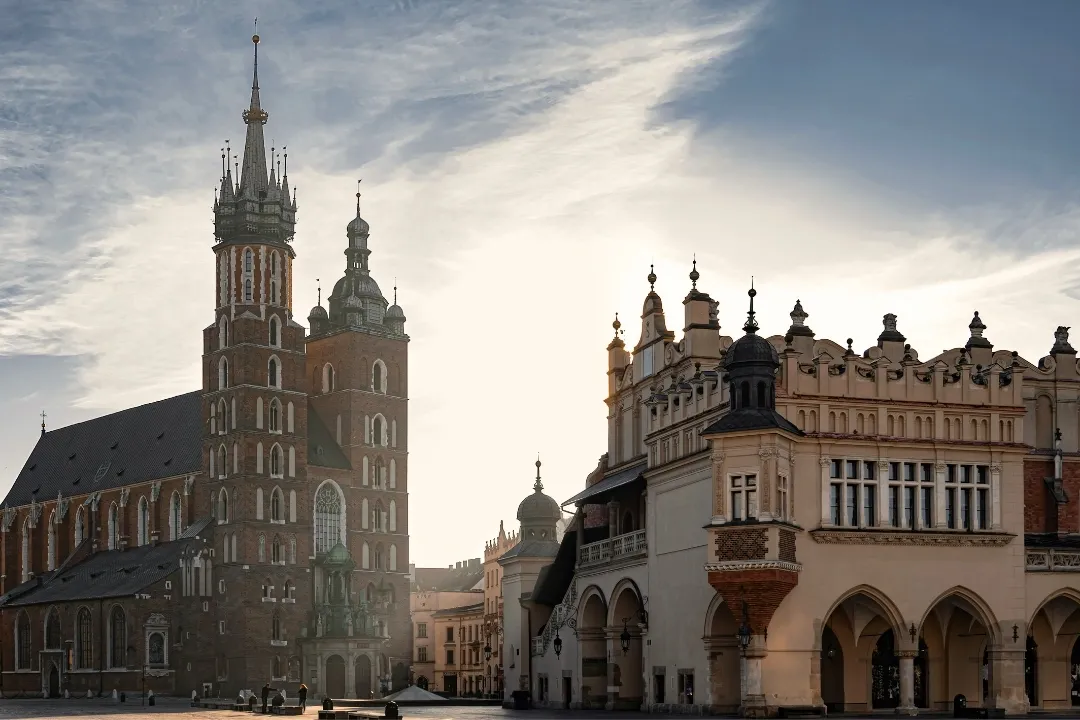
St Mary’s Church
You’ll recognise the Gothic St Mary’s Church straight away. This monumental building has two towers of different heights. From the taller one, known as the Hejnalica, a bugle call rings out every hour. The most valuable feature of the interior is the 15th-century altar by Veit Stoss.
After purchasing a separate ticket, you can climb to the viewing platform and admire the city panorama. The climb involves 239 steps, and the platform is situated around 54 metres above the Main Market Square.
Looking for attractions for children in Cracow? You can encourage the little ones to visit St Mary’s Basilica by telling them the legend of the yellow slipper.
The Cloth Hall
The Cloth Hall is one of Cracow’s most recognisable symbols. The first merchants’ stalls appeared in the centre of the Main Square as early as the 13th century.
The ground floor still houses shops selling jewellery, handicrafts and souvenirs. The first floor is home to the Gallery of 19th-Century Polish Art. Among the works on display are Jan Matejko’s ‘The Prussian Homage’ and Henryk Siemiradzki’s ‘Nero’s Torches’.
Wawel
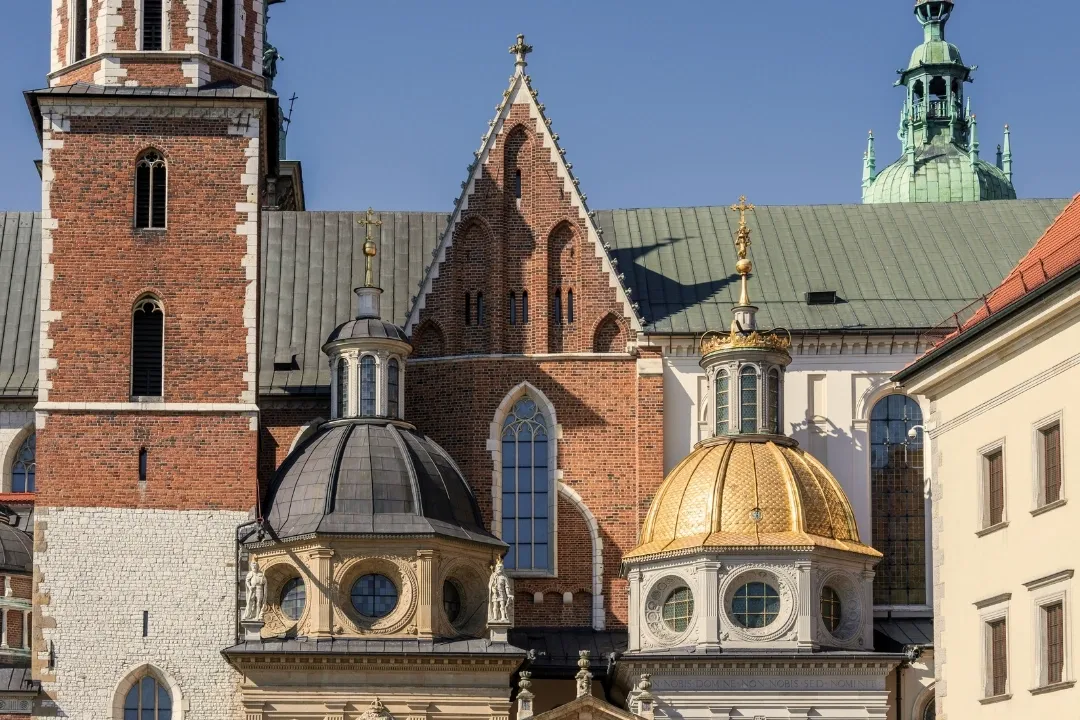
No list of Cracow’s top attractions would be complete without Wawel. We most often associate the name with the palace itself, but it is worth noting that Wawel encompasses an entire complex of historic buildings.
The hill is home to the Royal Castle, Wawel Cathedral, courtyards, gardens and the remains of ancient structures.
The castle exhibitions are divided into separate tours, including the Royal Chambers, the Crown Treasury and the underground passages. A separate ticket is required to visit the cathedral, Royal Tombs, Sigismund’s Bell and the Cathedral Museum.
If you’re planning to visit Cracow in a single day, Wawel should be the highlight of your trip.
The Barbican
The Barbican was built at the end of the 15th century to strengthen the defences of St Florian’s Gate. The circular structure has seven turrets, thick brick walls and arrowslits arranged on several levels. In the past, the two structures were connected by a narrow passageway known as the ‘neck’.
Grodzka Street and the Church of St Peter and St Paul
Grodzka Street was part of the Royal Route and led from the Main Square towards Wawel. Its course differs from the regular grid of streets laid out during Cracow’s medieval foundation, as the route had existed previously.
Two churches of completely different styles stand on this street. The Romanesque Church of St Andrew is characterised by thick walls and two slender towers. A few dozen metres further on stands the Baroque Church of St Peter and St Paul, with a light-coloured façade and a row of statues of the apostles in front of the entrance.
Kanonicza Street
Kanonicza Street runs from the vicinity of Senacka Street almost right up to Wawel Hill. The townhouses have retained their medieval walls, while their façades, portals and courtyards date mainly from the Renaissance and Baroque periods. The view down the street is framed by the buildings of Wawel.
The Archdiocesan Museum is housed at numbers 19 and 21. The exhibition showcases sacred art and memorabilia associated with Karol Wojtyla.
Basilica of St Francis of Assisi
The Franciscan Basilica stands on All Saints’ Square, a few minutes’ walk from the Main Market Square. Its austere, brick façade gives no hint of the interior’s colourful decoration. While historic architecture may not be the most obvious attraction for children in Cracow, in this case it may well intrigue the little ones.
The walls of the chancel are covered with polychromes by Stanislaw Wyspianski, while his monumental stained-glass window ‘God the Father – Let there be!’ dominates the entrance..
Attractions in Cracow for Children and the Whole Family
A family day out shouldn’t just be a scaled-down version of Cracow’s packed programme of attractions for adults. In the city, you’ll find places where you can explore a real cave, make obwarzanek and try out devices that help you understand the laws of physics.
Discover the best attractions for children in Cracow – whatever their age.
ZOO
Krakow Zoo is situated in Wolski Forest, away from the dense urban development of the city centre. Across its vast, undulating grounds, you can stroll among enclosures, pavilions and aviaries housing animals from every continent. You’ll see, among others, Indian elephants, giraffes, Humboldt’s penguins, big cats and numerous species of monkeys.
Dragon’s Cave
The entrance to Dragon’s Cave is on Wawel Hill, near the Thieves’ Tower. The entire cave is 270 metres long, though only an 81-metre section is open to visitors.
A flight of 135 steep, winding steps leads to the first chamber (we advise against attempting the descent with a pushchair). The route then passes through limestone chambers and ends at the foot of Wawel. The cave is open seasonally, and the route can only be walked in the direction of the Vistula Boulevards.
What to see in Cracow? Definitely the Wawel Dragon, which awaits you at the entrance to the cave. Bronisław Chromy’s metal sculpture regularly breathes real fire!
The Living Obwarzanek Museum
What can you do in Cracow? Make traditional baked goods with your own hands!
At the Living Obwarzanek Museum, you won’t just be looking at the pastries in display cases. The visit takes the form of one-hour workshops covering the history of this Cracow speciality, the legal protection of its name and its distinctive shape.
During the workshop, you can also make your own obwarzanek.
Workshops for visitors aren’t held every day, so you’ll need to check the schedule in advance and book online via the website. The museum is located on Paderewskiego Street, near the Barbican, so it’s easy to combine a visit with a tour of Cracow’s most popular sights.
The Stanislaw Lem Garden of Experiments
And what about attractions for older children and teenagers? In Cracow, you’ll find the Garden of Experiments, featuring more than 100 outdoor stations.
You can touch the exhibits, set them in motion and carry out experiments yourself. The installations demonstrate various phenomena related to optics, acoustics, motion, water and magnetism. Brief instructions next to the exhibits allow you to explore at your own pace without a guide.
WOMAI Centre for Science and the Senses
Let’s take a look at one of Cracow’s more unusual attractions. WOMAI offers two distinct ways of exploring the world around you.
- The exhibition ‘Towards the Light’ uses experiments relating to colour, sound and the laws of physics.
- ‘Towards Darkness’ takes place in complete darkness and offers an insight into the everyday experiences of blind people through hearing, touch and spatial orientation.
What to See in Cracow? The Top Museums
When you hear the word ‘museum’, do you picture one big, grey and ‘boring’ building? Fortunately, learning about Polish history no longer has to involve reading long descriptions next to exhibits in display cases. So, what does Cracow have to offer in this regard?
The National Museum in Cracow
The National Museum in Cracow has many branches, each presenting a different part of the collection. The Main Building houses the Gallery of 20th- and 21st-Century Polish Art. The exhibition takes you from the Young Poland movement through the avant-garde and post-war art to the very latest works. A separate section is dedicated to decorative arts, while the remaining rooms are reserved for temporary exhibitions. If you’re looking for new things to do in Cracow, it’s worth checking the current programme.
A visit to the Main Building itself is a good complement to the Gallery of 19th-Century Polish Art in the Cloth Hall.
Oskar Schindler’s ‘Emalia’ Factory
The name suggests a biographical museum, but Oskar Schindler is just one of the figures featured in the exhibition. The main exhibition, ‘Cracow – The Occupation 1939–1945’, tells the story of the city’s inhabitants: Poles, Jews and Germans.
The exhibition spaces feature displays illustrating everyday life under occupation, the establishment of the ghetto, the terror, forced labour and the liquidation of the Jewish quarter. Instead of a series of display cases, there are reconstructions of streets, the railway station, flats and Schindler’s office. Original photographs, documents and recordings of eyewitness accounts lend a personal dimension to the narrative.
After your visit, you can walk to Ghetto Heroes’ Square and the Eagle Pharmacy. All three sites form part of the museum’s Route of Remembrance.
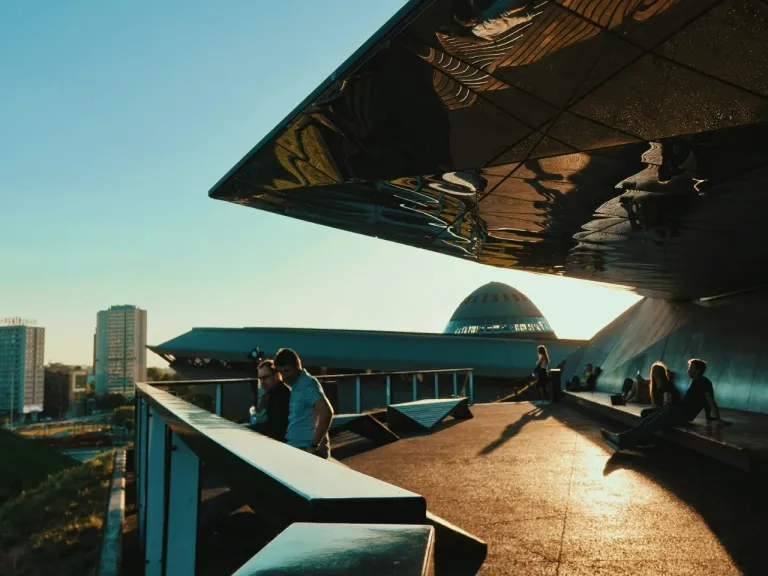
MOCAK – Museum of Contemporary Art
You don’t need to know the names of contemporary artists to get the most out of a visit to MOCAK. The works explore themes of memory, politics, the body, the media and social relations. Alongside paintings, there are films, photographs, installations and objects that cannot be confined to a traditional frame.
Part of the museum is housed in the former halls of Schindler’s Factory. The zigzagging roofs of the industrial buildings served as the starting point for the new structure. Art also extends beyond the exhibition halls. Sculptures and installations from the ‘Collection around MOCAK’ are situated around the buildings. The outdoor area can be viewed without a ticket.
The Market Square Underground
Beneath the paving of the Main Market Square, roads, market stalls and traces of everyday life from hundreds of years ago have survived. They were uncovered during archaeological excavations carried out between 2005 and 2010.
Footbridges lead over the remains of the medieval city, while ancient coins, ornaments and tools reveal what was traded in Cracow. The underground section covers an area of approximately 3,400 m².
The Archaeological Museum in Cracow
From Neanderthals to the inhabitants of medieval Cracow, the exhibition ‘Prehistory and the Middle Ages of Lesser Poland’ showcases several thousand years of the region’s history.
The museum’s building harbours an unexpected past. The former monastery served as a prison and a court for a time.
The Czartoryski Museum
Most visitors come here for ‘Lady with an Ermine’. The portrait painted by Leonardo da Vinci is the artist’s only work in Polish collections. Is this one of the most interesting attractions in Cracow? It is certainly one of the best known. However, it is worth venturing beyond the room housing Cecilia Gallerani.
The collection includes Rembrandt’s ‘Landscape with the Good Samaritan’, artefacts from ancient Egypt, weapons, porcelain, tapestries and memorabilia associated with Polish rulers.
The museum’s origins date back to 1801. Izabela Czartoryska collected works of art and objects related to the country’s history in Pulawy. The collection was moved away and hidden on numerous occasions to save it from destruction. Part of the collection was lost during the Second World War, including Raphael’s famous ‘Portrait of a Young Man’, which has still not been found.
Polish Aviation Museum
In this case, it is not the screens or reconstructions that make the greatest impression, but the real aeroplanes on display almost within arm’s reach. The Polish Aviation Museum’s collection comprises over 250 aeroplanes, gliders and helicopters, as well as more than 140 engines. The aircraft occupy the hangars and a vast section of the former Rakowice-Czyzyny airfield, which opened in 1912.
Free Attractions in Cracow – What Can You See Without a Ticket?
Cracow reveals a significant part of its history through its gates, squares, courtyards and hills. Most of these places are accessible free of charge, at least to some extent.
Whilst out walking, it’s worth taking a closer look at your surroundings, even if you’re not a fan of historic architecture.
Let’s move on to our list of free attractions in Cracow. Find out where to go and what to look out for.
Florianska Gate
We’ve already mentioned Florianska Gate when describing some of the most interesting places to visit in Cracow.
On the Barbican side, look out for the Piast eagle designed by Jan Matejko. Above Florianska Street stands a statue of St Florian, while beneath the vault, a small altar dedicated to Our Lady of Piaskowa has survived. The tower once marked the northern boundary of medieval Cracow.
Of the eight city gates, only Florianska Gate has survived. Its 34-metre-high structure illustrates the scale of the city’s former defensive system.
Kazimierz
Kazimierz is a peaceful and romantic district. As well as being one of Cracow’s most interesting areas, it is an obvious choice for couples looking to book a charming place to stay.
Wolnica Square serves as a reminder that Kazimierz, now a district of Cracow, had its own market square, town hall and local authorities for centuries. Krakowska Street ran through the Christian part of the city, where the Churches of Corpus Christi and St Catherine were built. A few blocks further on, Szeroka Street was the heart of the Jewish quarter.
Looking for lovely spots in Cracow? You’re sure to find plenty of them in Kazimierz. Just take a stroll and admire the surroundings.
The Courtyard of Collegium Maius
Beyond the gate on Jagiellonska Street lies a quadrangular courtyard with Gothic arcades, a stone well and steep roofs. The former college served as a workplace, dining area and residence for the professors. The entrances to their rooms still open onto the cloisters.
At specific times, the clock above the arcades takes centre stage. The mechanical procession depicts figures associated with the Cracow Academy, including Queen Jadwiga, Wladyslaw Jagiello and Hugo Kollataj. The figurines move to the sounds of court music and ‘Gaudeamus igitur’.
The courtyard itself is a free attraction in Cracow, but a ticket is required to visit the museum exhibition. Nevertheless, it is well worth a visit, particularly to see the clock.
Outdoor Attractions in Cracow
Once you’ve visited the main museums, basilicas and historical sites, you’ll no doubt feel like slowing down a little. At times like these, rather than heading back to your hotel, why not explore Cracow’s outdoor attractions?
Take a break from the crowds typical of the Old Town while continuing to explore the city. If the weather’s on your side, lie down on the grass and recharge your batteries before heading off for more sightseeing.
Cracow’s Planty
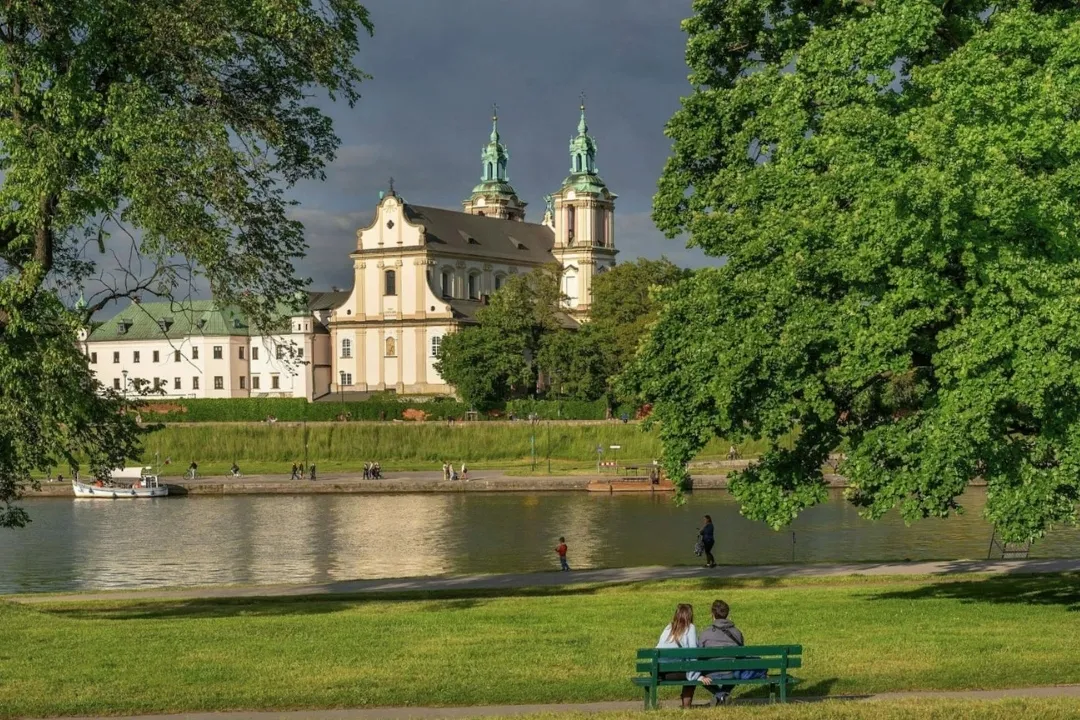
Cracow’s Planty is a park surrounding the Old Town. This four-kilometre-long strip of greenery stands where the old walls, ramparts and moats once stood. The route runs past the Barbican, the Slowacki Theatre, the Collegium Novum and Wawel.
Cracow’s Blonia
This vast meadow, not far from the city centre, covers 48 hectares. An asphalt loop runs along its edge for cyclists, roller-skaters and runners. Jordan Park begins at its northern edge.
Cracow’s Mounds
Who built Cracow’s oldest mounds, and for what purpose? We still have no definitive answers to these questions.
Krakus Mound in Krzemionki is said to have been the burial mound of Prince Krak, while Wanda’s Mound in Nowa Huta is attributed to his daughter. The exact date when both mounds were built remains unknown. Archaeologists link them, among other things, to ancient rituals or astronomical observations.
Three later mounds commemorate figures from Polish history. The 19th-century Kosciuszki Mound towers over St Bronislawa’s Hill. The largest is the Pilsudski Mound, built on Sowiniec in the Wolski Forest. It is approximately 35 metres high. The newest and smallest, the John Paul II Mound, was erected in 1997 on the grounds of the Congregation of the Resurrectionist Fathers.
Each mound offers a different view of the city. A walk along their trail can be an interesting and, at the same time, free attraction in Cracow. From Krakus Mound, you can see Podgorze, the Liban quarry and the historic centre. Wanda’s Mound offers a panoramic view of Nowa Huta, while the summits of the Kosciuszki and Pilsudski mounds reveal the western part of the city and the distant mountain ranges.
Zakrzowek
Zakrzowek is a recreational area built around a former limestone quarry. Paths run alongside the reservoir, and there are numerous viewpoints above the water.
In summer, there is a free swimming area here. If you’re looking for things to do with children in Cracow on hot days, Zakrzowek is an excellent choice.
Wolski Forest
Stretching across the western hills of Cracow is Wolski Forest – a vast woodland with a network of walking trails. Individual trails lead to the zoo, the Pilsudski Mound and the Panienskie Skaly Gorge. Comfortable footwear is advisable on the hilly and, in places, muddy sections.
Attractions Around Cracow
There is no shortage of interesting attractions in Cracow. Nevertheless, many places worth visiting can also be found in the city’s immediate surroundings. Keep them in mind when planning the rest of your sightseeing itinerary.
The Wieliczka Salt Mine
The underground tour in Wieliczka leads through corridors and chambers carved out of salt. The most impressive sight is St Kinga’s Chapel, adorned with salt sculptures, reliefs and chandeliers.
The tour lasts 2–3 hours, and the temperature underground remains around 17–18°C all year round.
Auschwitz-Birkenau
The Auschwitz-Birkenau Memorial Site is situated in Oswięcim, about 70 kilometres from Cracow. A guided tour of Auschwitz I and Auschwitz II-Birkenau usually takes around 3.5 hours. Admission tickets must be booked online in advance.
Ojcow National Park
Ojcow National Park delights visitors with its limestone cliffs, caves and the green Pradnik Valley. The trails lead past the Cracow Gate, the ruins of Ojcow Castle and Hercules’ Club. In the northern part of the park lies the Renaissance castle at Pieskowa Skala.
Lanckorona and Kalwaria Zebrzydowska
Lanckorona is a small village famous for its sloping market square and wooden houses with wide eaves. The ruins of a medieval castle still stand above the village. A few kilometres further on lies Kalwaria Zebrzydowska, with its basilica, monastery and a complex of chapels on the surrounding hills. The entire complex is listed as a UNESCO World Heritage Site.
Alpaca Park
Alpaca Park is located in Przebieczany, not far from Wieliczka. During your visit, you can see alpacas up close, feed them and go for a short walk with them.
Mnikowska Valley
Mnikowska Valley is a small nature reserve situated west of Cracow. The trail runs along the Sanka stream, among limestone rocks, meadows and wooded slopes. This short and gentle walk is also ideal for a day out with children.
A shorter stay in the capital of Malopolska is best spent exploring the city centre and one district outside the Old Town. There’s certainly no shortage of weekend attractions in Cracow, many of which are within easy walking distance.
If you’re staying longer, you could set aside a separate day for Wieliczka, Ojcow National Park, or Lanckorona and Kalwaria Zebrzydowska.
So, which attractions in Cracow and the surrounding area have piqued your interest the most? Do you already have a plan for your stay?